An alcove wardrobe needs room for clothes on hangers and doors that open freely. Before choosing the finish, check the depth behind the doors and the space in front: can you open a door, pull out a drawer and stand beside it to reach inside? These clearances determine how easy the wardrobe is to use every day.
How deep should an alcove wardrobe be?
The depth of the alcove and the space behind the closed doors are different measurements. The back panel, fronts and opening mechanism all take up room. A 60 cm alcove does not give you 60 cm of clear storage depth.
For an initial check, take a hanger with your bulkiest jacket and hold it across the alcove. Allow for where the closed door will sit. The sleeves should not press against it. That small check tells you more than choosing a depth from a photograph of someone else's wardrobe.
For comparison, IKEA PAX frames come in depths of 35 and 58 cm. These belong to a particular system, not a standard for all fitted furniture. In a shallow alcove, consider a different rail arrangement or shelves for part of the space. You cannot simply shrink a deep wardrobe on a drawing: your clothes stay the same size.
Let your belongings decide the compartment widths
Look inside the wardrobe below. There is a tall hanging section on the left, two levels of rails on the right, narrow shelves between them and drawers at the lower left. Long clothes need clear height, shorter garments can hang on two levels, and shelves divide up folded items.
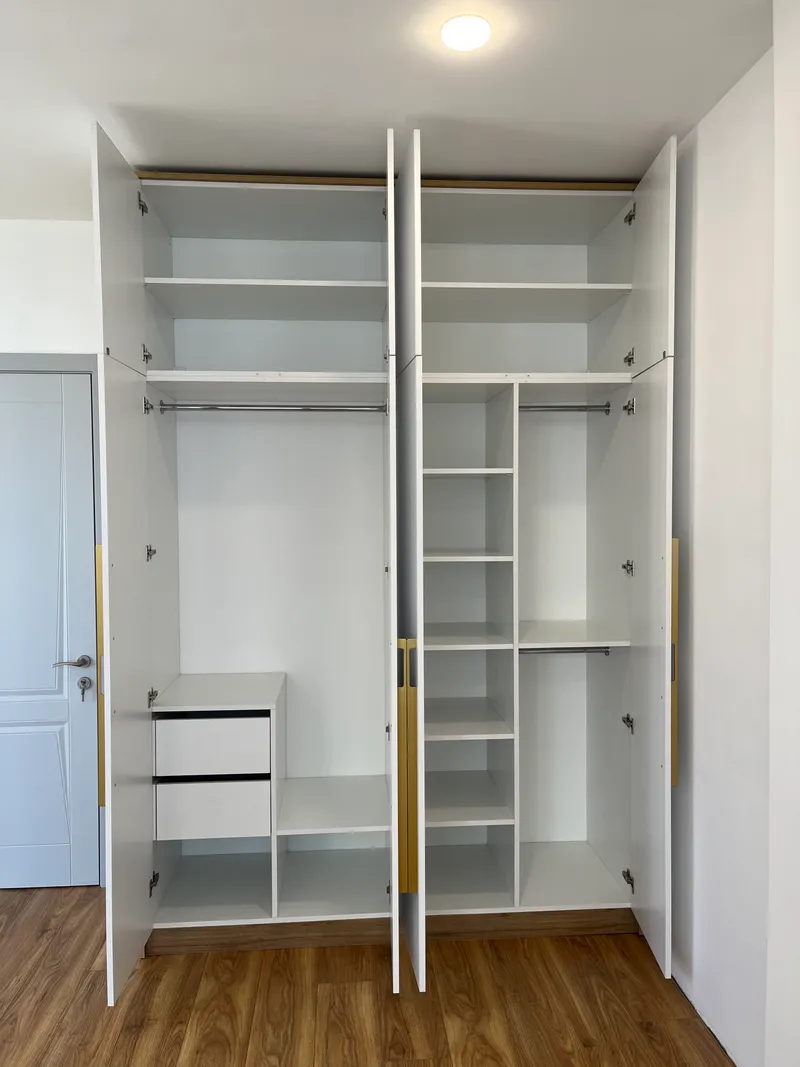
List large items separately: a suitcase, ironing board, drying rack or vacuum cleaner. Each needs a compartment and a clear opening large enough to take it out. Include handles and wheels when measuring a suitcase.
Wide shelves need suitable material and support for the weight they will carry. Dividing the alcove into equal sections should follow the storage discussion. Symmetrical doors alone do not make the inside practical.
Planning a wardrobe up to the ceiling
Use upper cupboards for seasonal belongings and rarely worn clothes. Keep bedding you change every week lower down. Before storing a suitcase at the top, check that you can lift it onto the shelf and take it down comfortably.
Check the height in several places. The design must allow for assembly, installation and the ceiling junction. Ordering a cabinet to match one floor-to-ceiling measurement can leave you with something that cannot be installed in the way you planned.
Hinged or sliding doors?
If a bed stands nearby, check the door swing and its handle. The door may open while the drawer behind it catches on the door itself. That calls for a change to the drawer position, door width or opening arrangement.
Sliding doors travel across the front, so they do not need swing clearance. Their tracks use depth, though, and one panel covers part of the opening. Drawers need to line up with a section that opens fully. Work that out together with the internal layout.
| Check | Why it matters |
|---|---|
| Depth behind the doors | Clothes on hangers should not press against the fronts. |
| Compartment and opening width | A suitcase needs to fit through the opening in both directions. |
| Height at several points | The design needs to allow for installation and the ceiling junction. |
| An open door and drawer | Both need to work beside the bed or wall. |
Choosing the finish
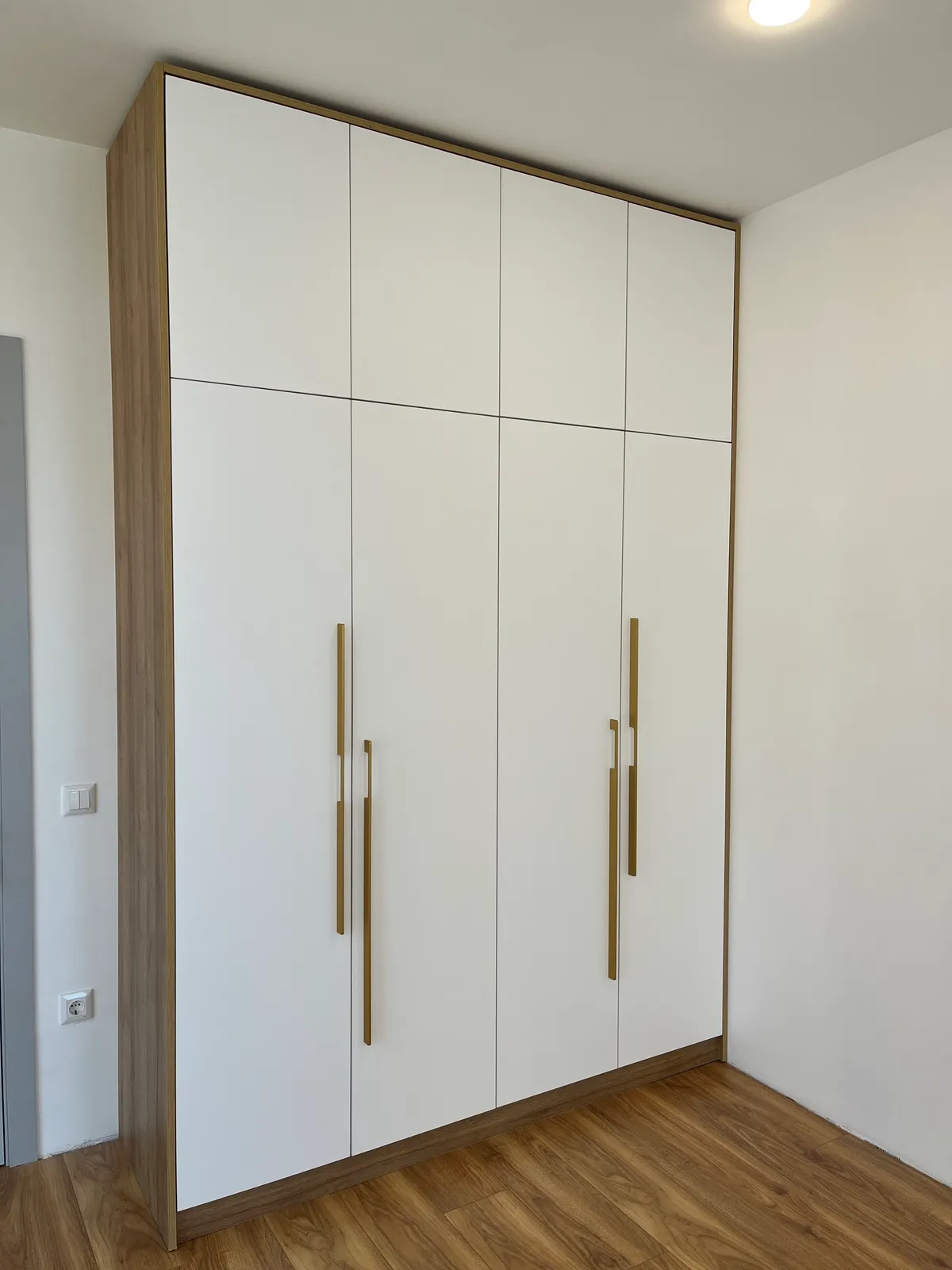
In these photos, light fronts sit within a wood-effect surround. Choose the colour together with the material and finish: these determine the surface and its care requirements. MDF fronts come with different finishes, so compare actual samples as well as material names.
Compare samples beside your room's wall and floor. Look at them in daylight and with the lights on, feel the surface and check how visible fingerprints are. A colour on a screen can look quite different at home.
If the alcove wall is damp, establish the cause first. EGGER, for example, makes a P3 board for humid conditions, but a moisture-resistant board does not solve a wet-wall problem. Deal with the room, then choose the material for those conditions.
Starting an estimate
Send a wide photo of the alcove and its approximate width, height and depth. Include the space in front: the bed, adjacent door, sockets and skirting. Tell me what you want to store. A simple list is fine: long clothes, shirts, bedding, two suitcases.
That gives us a starting point to discuss a custom wardrobe in Batumi and an estimate. Final manufacturing dimensions are checked on site. If the wardrobe is for your entrance, have a look at our hallway project too: the storage needs there are different.